Other People's Databases and Workarounds Are Not Cutting It for Public Health Teams

You submit data to the state every quarter. You upload files to your funder's portal. You log into NDSS, send exports to Changent, fill out PDFs for Title V. You're connected to a dozen different databases.
But ask yourself: when your Board of Supervisors wants to know how many families you served last year, how long does it take to answer?
If it's more than five minutes, what you have isn't a system—it's obligations to other people's systems, with duct tape filling the gaps. And you've been making it work for so long that it feels normal.
It shouldn't have to be normal. This is what happens when an entire sector gets left behind.
Public Health Ran on Scraps While Everyone Else Modernized
Hospitals spent billions on electronic health records. Private practices got scheduling software, patient portals, automated billing. Meanwhile, public health programs kept running on Access databases built during the Bush administration, spreadsheets lived on shared drives, and institutional knowledge walked out the door every time a program coordinator retired.
The technology existed. It just wasn't built for you.
Clinical EHRs were designed for encounter-based, billing-driven care—a patient shows up, receives a service, generates a claim. That's not what a home visitor does when she spends eighteen months building trust with a young mother. Enterprise systems were built for centralized facility operations—not for a community health worker doing street outreach from a county car, entering notes on a phone between stops.
So public health improvised. Program managers became accidental database administrators. PHNs learned to document the same visit three different ways for three different funders. MCAH directors spent more time reconciling spreadsheets than actually using data to improve outcomes.
You made it work. But "making it work" has a cost—and your staff pay it every day.
The Work You Do Doesn't Fit the Tools You Were Given
The mismatch isn't just inconvenient. It's structural.
Clinical systems assume predictable demand: patients seek care, show up at facilities, and generate billable encounters. Public health is the opposite. Your workers find clients, engage them, coax participation from people who've learned to distrust systems. The pipeline is uncertain. Funding comes from grants, not fee-for-service. Success is measured in outcomes over months and years, not procedures performed.
Your home visitors aren't documenting encounters—they're managing care plans, coordinating referrals to WIC and early intervention and housing, tracking assessments and follow-ups across a family, not an individual. The unit of work is the relationship, and it unfolds in living rooms and shelters and schools, not exam rooms.
Software built for hospitals will never fit that reality. And forcing it to fit is why your team spends hours on documentation that should take minutes.
What It Looks Like When the Software Actually Fits
The work of public health—whether it's MCAH, home visiting, or behavioral health outreach—follows a common rhythm: get people into the program, do the work, report on it. Enrollment, care coordination, reporting.
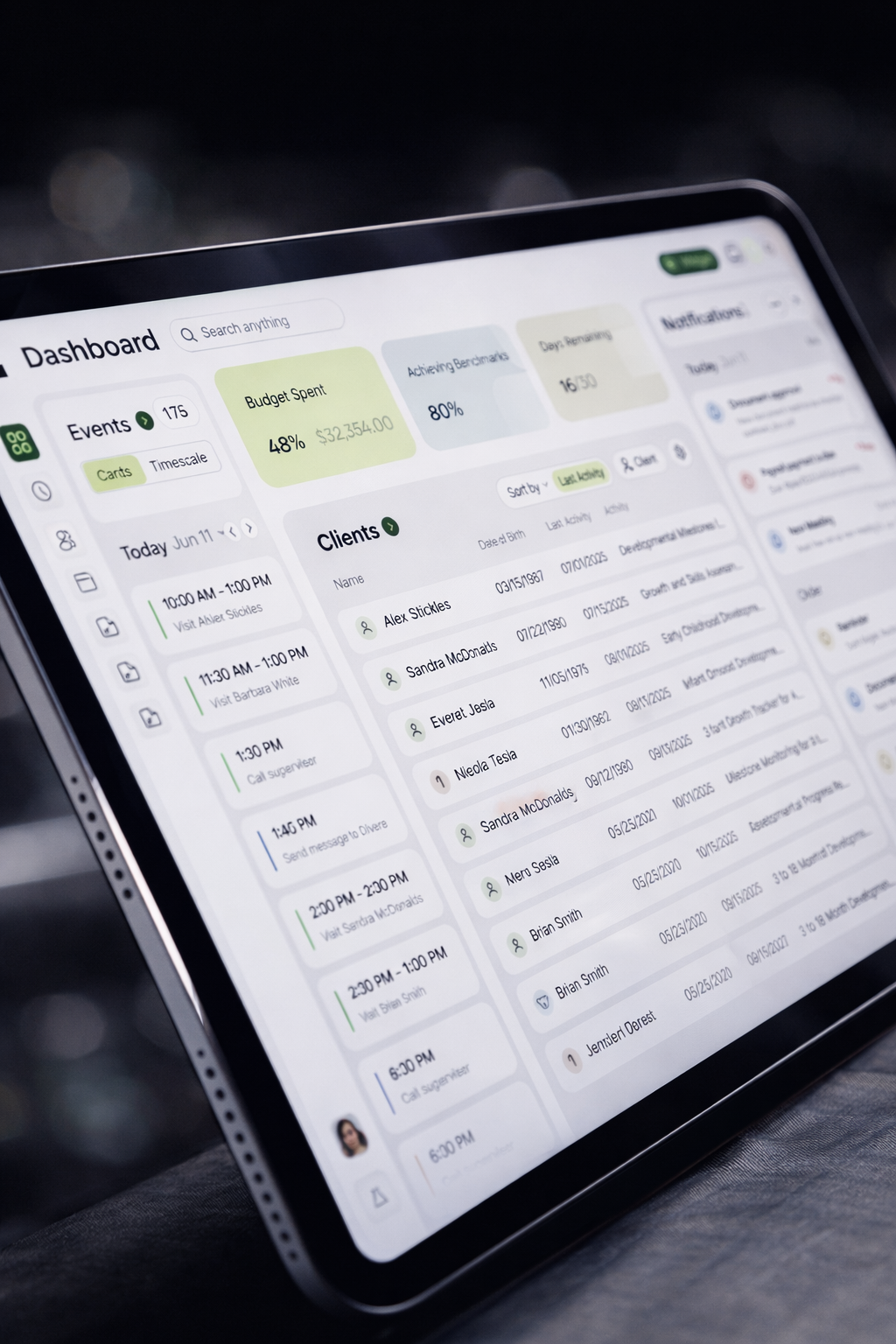
A system built for that rhythm handles referrals however they arrive—face-to-face, phone, fax from a hospital, a partner using your referral portal—without duplicate entry. It lets supervisors see caseloads at a glance, assign and reassign clients, review and approve documentation. It gives your family advocates and peer support specialists and community health workers tools that make their jobs easier, not compliance checkboxes that slow them down.
And when it's time to report—to MIECHV, to the state, to your own leadership—the data is already there, in the format you need, without two weeks of pulling and cleaning and praying nothing got missed.
The Difference Between Compliance and Capability
Submitting your data on time is compliance. Knowing which families haven't been seen in three weeks, understanding what's working across your programs, onboarding new staff in days instead of months—that's capability.
Public health has been stuck on compliance for decades because the tools for capability didn't exist. You've been so busy feeding other people's databases that you never got a system of your own.
That can change.
Persimmony is a case management platform built for public health, home visiting, and community-based programs. We support over 600 programs across health, mental health, and social services—because field work isn't clinical work, and your team deserves software that knows the difference.